

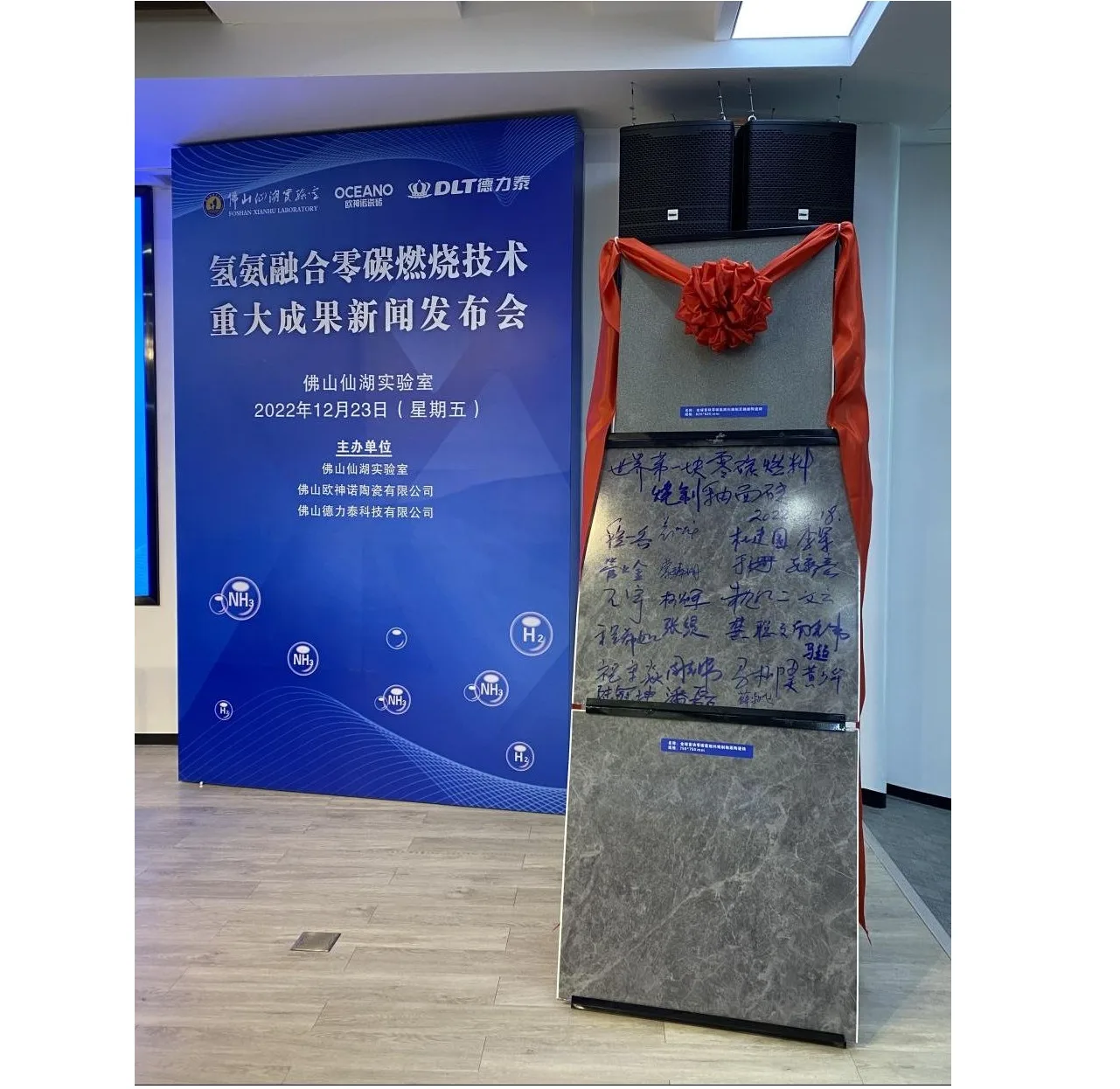
On 23 December, Foshan Xianhu Laboratory held a press conference on a major achievement in hydrogen–ammonia zero-carbon combustion technology. It announced that the world’s first green ceramic tile fired with zero-carbon ammonia fuel had been successfully produced in Foshan, Guangdong Province, on 18 December 2022. The result was jointly developed by Foshan Xianhu Laboratory, Foshan Oceano Ceramics Co., Ltd. and Foshan Dalitai Technology Co., Ltd., and marks a historic step by China’s building ceramics industry towards carbon neutrality.
1. Project background
Building ceramics are fired at 1200 °C, currently using mainly fossil fuels such as natural gas, coal and heavy oil, which produce large amounts of carbon dioxide. Under China’s carbon peaking and carbon neutrality goals, the ceramics industry faces enormous pressure to cut CO2 emissions. Switching to advanced zero-carbon fuels is one of the most fundamental, direct and effective ways to reduce carbon, and is an urgent demand that high-temperature manufacturing places on scientific and technological innovation in this new-energy revolution. At present, only two zero-carbon fuels are suitable for large-scale industrial use: hydrogen (H2) and ammonia (NH3). Neither contains carbon, so their combustion at high temperature produces no carbon emissions. Because industrial kilns consume huge quantities of fuel and large-scale storage and transport of hydrogen is very difficult, the use of hydrogen as a fuel in high-temperature industry is severely limited.
Ammonia is a compound of hydrogen and nitrogen. It has been synthesized for more than 100 years and is used mainly as an agricultural fertilizer and chemical feedstock. Technologies, infrastructure and transport standards for the safe storage and transport of ammonia are relatively mature. Most importantly, ammonia can be stored and transported in large volumes at a cost far lower than hydrogen (only about 1%), making ammonia fuel clearly more economical than hydrogen fuel. However, ammonia is hard to ignite and hard to burn, and produces nitrogen oxides when burned at high temperature. These are the challenges that must be solved to develop zero-carbon ammonia combustion technology.
2. Research and development
On 27 December 2021, Foshan Xianhu Laboratory, Foshan Oceano Ceramics Co., Ltd. and Foshan Dalitai Technology Co., Ltd. jointly established the Advanced Zero-Carbon Combustion Technology Joint Innovation R&D Center, directed by Professor Cheng Yibing, strategic scientist of Foshan Xianhu Laboratory. The center targets disruptive key technologies for zero-carbon combustion in ceramic kilns, aiming to explore new directions for China’s ceramics industry to meet its carbon goals and to extend advanced zero-carbon combustion technology to other high-temperature manufacturing industries.
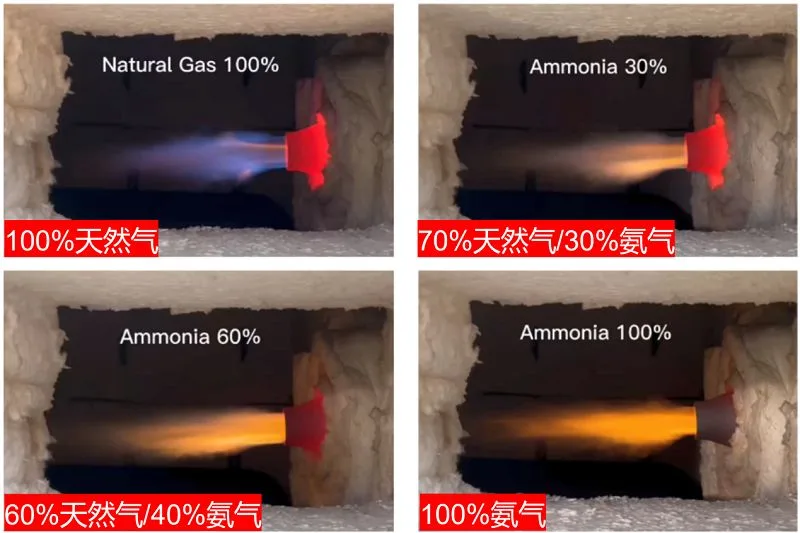
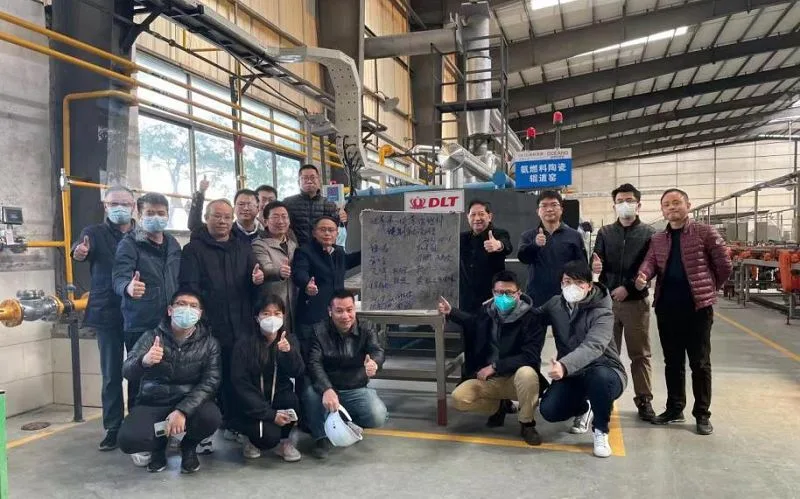
After nearly a year of work, the joint R&D center designed and developed new industrial burners for pure ammonia and for natural gas blended with ammonia, together with supporting technologies. In Dalitai’s industrial test furnace it achieved stable ignition and stable combustion with ammonia blending and with pure ammonia (Figure 2), while keeping nitrogen oxide emissions within national standards. Alongside the zero-carbon combustion technology, the team established a complete set of safety rules and emergency management measures for ammonia-fuelled ceramic kilns, covering key steps such as operating procedures and ammonia storage and transfer. On this basis, the team retrofitted a 30-metre roller kiln at Oceano Ceramics, converting it from natural gas to pure ammonia and natural gas–ammonia blends. The team also developed a liquid-ammonia vaporization and precise supply control system suited to pure-ammonia combustion and an online monitoring system for residual ammonia in flue gas, and, with Guangdong Anqing Technology Co., Ltd., developed an efficient liquid-ammonia SCR denitrification system and other complete sets of technology and equipment (Figure 3).

3. Project assessment
Because ammonia had never before been used as a fuel in ceramic kilns, there were no industry standards or technical specifications, leaving no basis for assessing the safety of tile production in the pilot kiln. On learning of this difficulty, the Guangdong Ceramics Association offered to organize industry experts to evaluate the project technically, to help advance this new carbon-reduction technology. On 11 November 2022, the association organized experts to inspect and assess the project “Ammonia Combustion (Zero-Carbon Fuel) Technology for Building-Ceramics Industrial Kilns” on site. The expert panel spoke highly of this disruptive innovation, concluding that ammonia combustion in building-ceramics industrial kilns is safe and controllable, that the technology and equipment developed fill gaps both in China and internationally, that it opens a new-energy technology route for the ceramics industry and the wider building materials sector to reach carbon peaking and carbon neutrality, and that it is of major practical significance for the building ceramics industry’s carbon goals. The panel recommended accelerating demonstration and pilot testing of the technology. Its assessment report cleared the way for the pilot.
4. Demonstration pilot
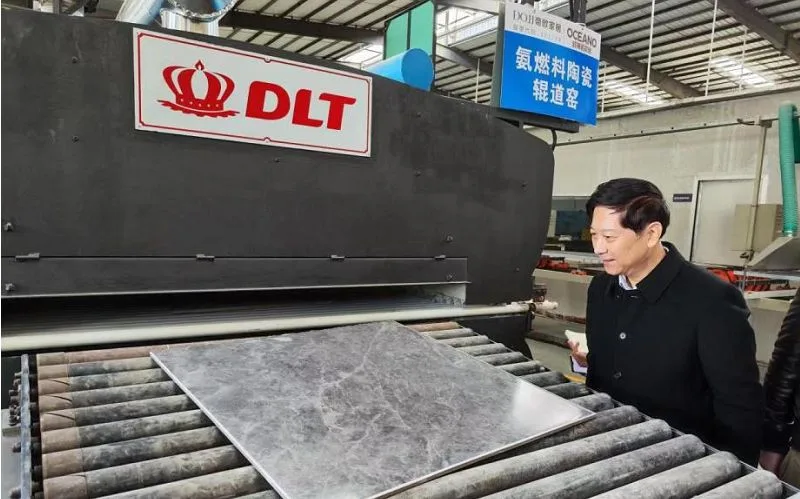
On 18 December 2022, the project “Ammonia Combustion (Zero-Carbon Fuel) Technology for Building-Ceramics Industrial Kilns” began demonstration trial production at Foshan Oceano Ceramics Co., Ltd. The retrofitted pilot kiln was ignited from cold and heated using 100% ammonia fuel. After the firing regime (temperature, atmosphere and pressure) was adjusted on site, tiles were fed into the kiln and the world’s first green tile fired with zero-carbon ammonia fuel came off the line.
The flue gas of the pure-ammonia kiln was sampled and tested on site by a qualified third party, and all pollutants (nitrogen oxides, sulphur dioxide, particulate matter and others) were below national limits. The 750 × 750 mm glazed tiles produced (Figures 4–5) showed no black cores or colour differences in cross-section, with normal pattern colours, water absorption of 0.01% and strength of 41.6 MPa, all exceeding the national standard for porcelain tiles.
5. Innovations and application prospects
Using innovative research results, the project overcame the difficulty of igniting industrial-scale pure-ammonia burners and the instability of their flames, achieving efficient and stable pure-ammonia combustion (combustion efficiency >99.9%, residual ammonia <5 ppm). It creatively combined staged combustion, SNCR and liquid-ammonia SCR to greatly reduce NOx emissions in the flue gas. More than 30 national patents have been filed for the project’s innovations.
Ammonia is a sustainable, renewable zero-carbon fuel that can be produced using clean energy such as wind and solar power. Firing ceramics with zero-carbon ammonia fuel is a disruptive innovation, a first both in China and internationally. It not only offers a disruptive technical solution for the building ceramics industry to meet its carbon goals, but also points to a clear and practical technical route for other high-temperature manufacturing industries to carry out their carbon peaking and carbon neutrality plans, which is of major practical significance. During development, the project also verified the feasibility of blending ammonia with conventional fossil fuel (natural gas) in any ratio, providing government and industry with a foreseeable and plannable implementation path towards carbon peaking and carbon neutrality. In future, high-temperature industries could first blend ammonia into existing fossil fuels to reach carbon peaking, then gradually raise the ammonia share and finally burn 100% pure ammonia to achieve carbon neutrality.
Foshan Xianhu Laboratory is now in active discussions with several leading companies in the ceramics and metal processing industries on cooperation in zero-carbon combustion technology. Further adoption of the technology will have major social benefits and make a significant contribution to high-temperature manufacturing in Guangdong and across China in meeting their carbon goals.
Foshan Xianhu Laboratory news link
Source: Foshan Xianhu Laboratory website