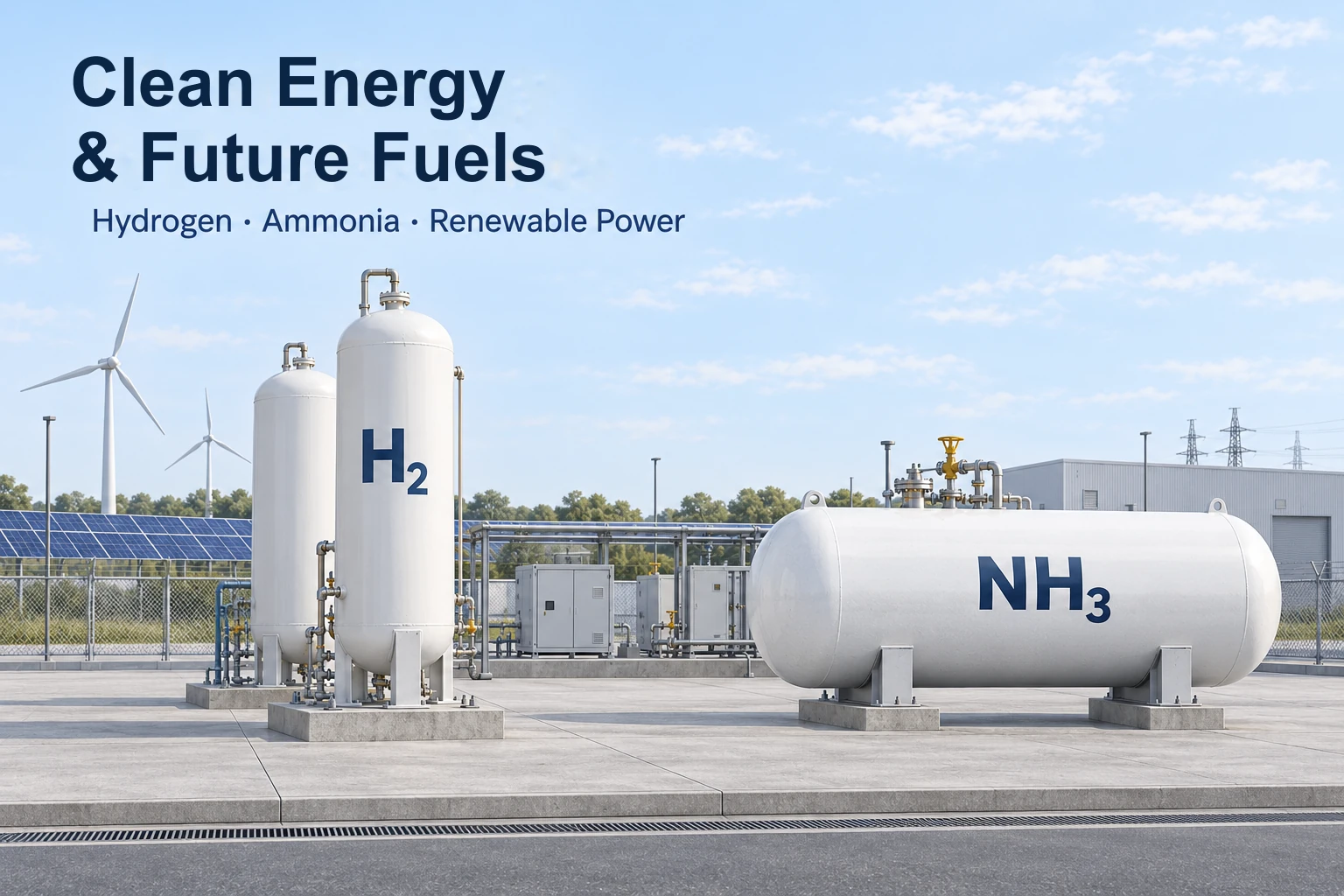
Addressing global decarbonization and future energy needs through low-carbon hydrogen production, green fuel synthesis, and efficient conversion and integrated use of ammonia and hydrogen.
Overview
Clean energy is essential to addressing climate change and achieving China’s carbon peaking and carbon neutrality goals. Renewable electricity is transforming energy supply, while industry and transport also require low-carbon fuels that are practical to store and transport. Hydrogen and ammonia can serve as chemical carriers of renewable energy, offering new options for industrial and power systems. Biofuels and synthetic fuels made with renewable electricity could help decarbonize aviation and shipping; the concept of “liquid sunshine” captures the conversion of renewable energy into liquid fuels. Our research explores low-carbon hydrogen production, green fuel synthesis, and ammonia–hydrogen energy conversion, connecting catalytic reactions with system-level applications.
Research themes
01Low-carbon hydrogen production and high-value carbon utilization
We explore efficient, low-carbon hydrogen production, with a focus on the pyrolysis of hydrocarbon fuels such as natural gas. Thermal or catalytic processes convert hydrocarbons into hydrogen and solid carbon. Research addresses catalyst activity and stability, reactor heat supply, and continuous operation, alongside the formation and quality control of carbon materials such as carbon black. We consider hydrogen production efficiency, process energy consumption, and the value of carbon products together.
02Green fuel synthesis and carbon recycling
We explore the production of ammonia, methanol, and other synthetic fuels using green hydrogen, as well as the conversion of biomass into liquid fuels. Research on catalytic materials, reaction pathways, and process design seeks to improve yields of target products, reduce energy consumption, and accommodate variations in renewable energy supply. Concepts such as “liquid sunshine” provide a starting point for exploring renewable energy storage and carbon recycling.
03Ammonia–hydrogen conversion and catalytic reactors
We study interactions among catalytic reactions, heat transfer, and mass transport in ammonia cracking for hydrogen production and the preparation of partially cracked ammonia. Combining catalyst development with reactor design, we examine how material composition, support structure, channel layout, and heating methods influence conversion efficiency and stability. We explore compact, modular ammonia–hydrogen conversion units that can accommodate variable loads across different scales and energy demands.
04Integrated ammonia–hydrogen energy systems and applications
We investigate how ammonia and hydrogen can complement each other across production, storage, transport, conversion, and utilization. Combining ammonia’s potential for large-scale storage and transport with hydrogen’s diverse applications, we explore energy solutions for industrial manufacturing, transport power, fuel cells, and electricity generation. We examine how the choice of energy carrier, degree of conversion, and energy supply strategy can meet practical requirements and support the integrated use of renewable electricity and chemical fuels.
Future directions
Addressing the needs of clean energy development and future green fuels, we will tackle key scientific and technical challenges in fuel production, conversion, and utilization through the coordinated design of catalysts and reactors, while exploring efficient, low-carbon energy conversion pathways. Guided by practical energy needs in industry and transport, we will investigate how green fuels can be matched to and jointly optimized with application systems to improve energy efficiency and expand their use in industrial manufacturing, transport power, distributed energy, and other settings.
Chinese Science Bulletin · 2023; 68(23): 3107–3112
Discusses integrated ammonia–hydrogen energy from an interdisciplinary and strategic perspective, covering energy production, storage, transport, conversion, and industrial applications.
Investigates the effects of materials and channel structures on ammonia decomposition reactors, connecting ammonia–hydrogen conversion with reactor design.