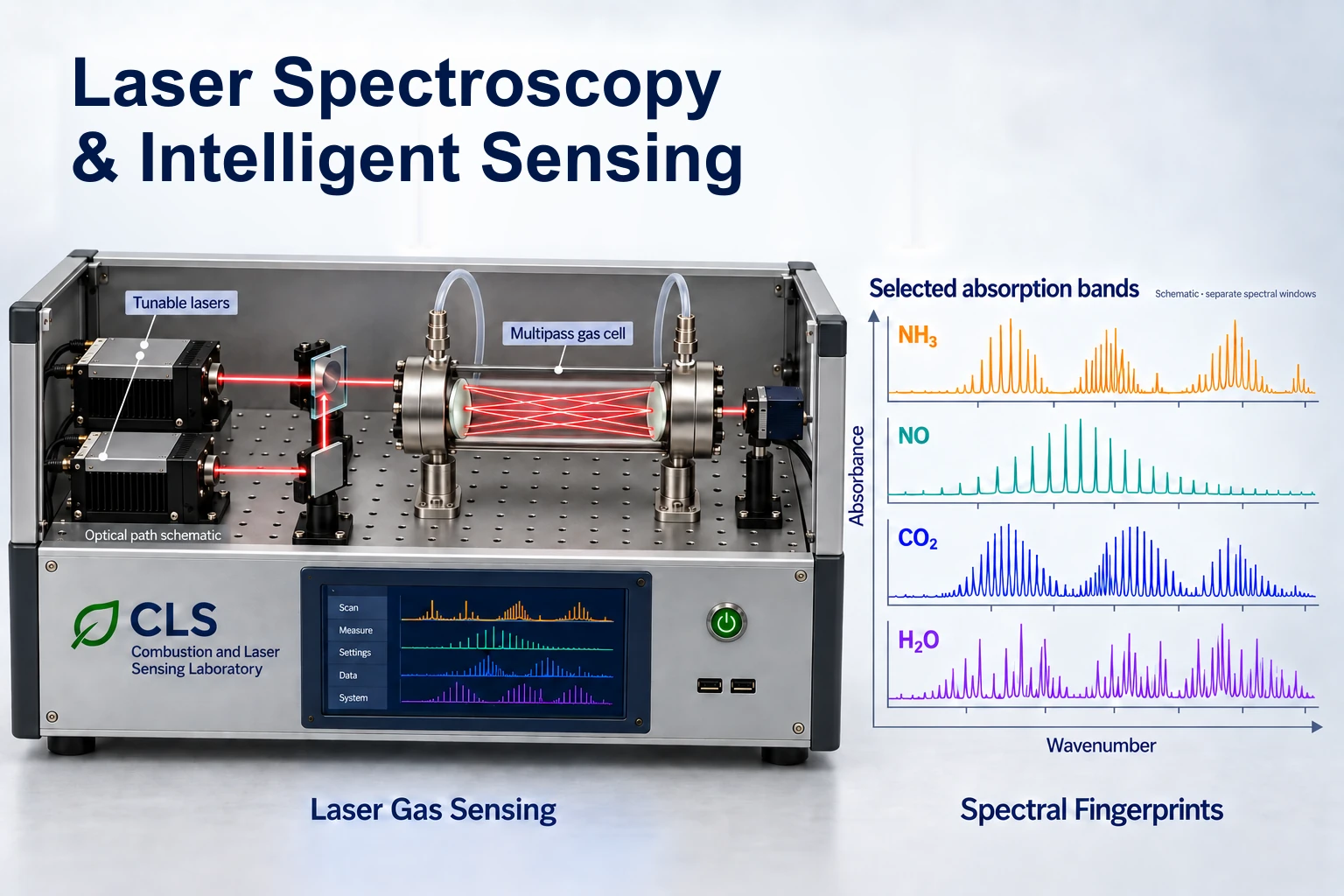
Developing accurate gas measurements and intelligent sensing instruments from molecular spectroscopic principles to support monitoring and control of complex industrial processes.
Overview
Industrial flue-gas measurements provide essential information for evaluating emissions, assessing equipment condition and optimizing operation. Water-vapor interference and changing operating conditions in complex industrial environments affect measurement accuracy and place demands on long-term instrument stability. Starting from laser spectroscopic principles, we combine spectroscopy with intelligent algorithms to improve signal analysis and quantitative measurements, with a focus on accurate detection in complex flue-gas mixtures. We also integrate instruments around field requirements so that advanced measurement techniques can operate in industrial environments with practical provisions for continuous operation and maintenance.
Research themes
01Advanced spectroscopy and quantitative measurements
We investigate changes in light intensity caused by molecular absorption and phase responses caused by dispersion, developing quantitative methods for different gases and measurement conditions. Through spectral-line selection, line-broadening analysis, modulation-based detection and multiline analysis, we examine the relationships between gas states and spectroscopic signals. We explore the complementary use of absorption and dispersion information to improve measurements of concentration, temperature and other parameters.
02Intelligent spectral analysis
We combine molecular spectroscopic models with machine-learning algorithms to investigate spectral-feature extraction, noise suppression, interference identification and parameter estimation. To address instrument drift, environmental changes and differences in data across operating conditions, we explore physical constraints, transfer learning and adaptive models that improve the accuracy and stability of quantitative analysis. Measurement uncertainty and interpretability are also considered so that intelligent algorithms can support reliable field measurements.
03Accurate measurements in complex industrial flue gas
For combustion-emissions and industrial-process monitoring, we investigate quantitative flue-gas measurements under high humidity, strong spectral interference and fluctuations in temperature and pressure. We examine the effects of water-vapor backgrounds, overlapping spectral lines, sample-gas adsorption, condensation and transport delays. By jointly optimizing sampling, spectroscopy and data processing, we aim to improve concentration-measurement accuracy, response speed and long-term stability, reliably characterizing flue-gas conditions and their dynamic changes.
04Intelligent instrument integration and engineering applications
We integrate advanced spectroscopic methods with optical, electronic, gas-handling and software systems to develop intelligent measurement instruments that are practical to deploy, operate and maintain in complex industrial environments. Considering changes in temperature and humidity, dust contamination, mechanical vibration and continuous operation, we investigate optical stability, environmental compensation, online self-checks and fault diagnosis to improve instrument robustness and operational reliability. Prototype development and field validation support the translation of high-performance measurement techniques into equipment suitable for long-term use.
Future directions
Building on advances in laser spectroscopy and measurement principles, we will develop measurement techniques for complex environments and dynamic processes, improving the accuracy, response speed, and stability of measurements of multicomponent gases and key state parameters. By combining intelligent spectral analysis with instrument integration, we will develop intelligent sensing instruments suited to field requirements in green-fuel conversion, industrial process monitoring, and pollutant emission control, advancing the use of spectroscopy in industrial monitoring and process regulation.
Investigates quantitative measurements and absorption-spectrum recovery using heterodyne phase-sensitive dispersion spectroscopy, contributing to advanced spectroscopic principles and measurement methods.
Investigates laser absorption measurements of NO and NH₃ in ammonia-combustion flue gas with very high water-vapor content, addressing quantitative detection in complex flue-gas backgrounds.
W. Duan, F. Yan, Y. Wang, H. Zhang, L. Ma*, D. Wen, W. Wang, G. Sheng, Q. Wang*
Sensors · 2022; 22(2): 556
Combines laser absorption spectroscopy with sensor design for highly sensitive gas detection, providing a research basis for integrating spectroscopic methods into instruments.