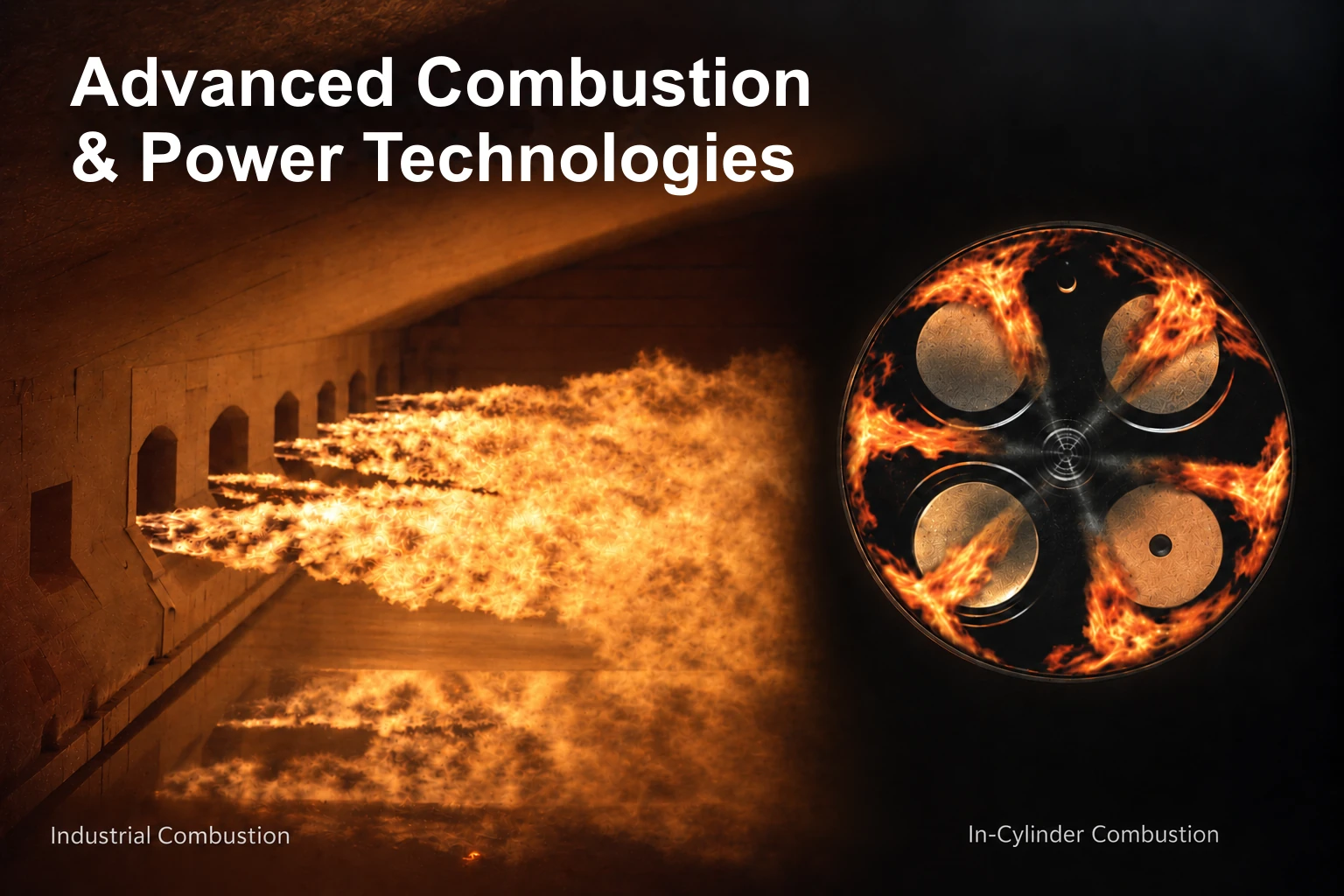
Uncovering the fundamental mechanisms of combustion and pollutant formation to develop efficient, low-emission technologies for industrial heating and clean power.
Overview
Combustion is a major means of energy conversion in industrial heating and power systems. Improving efficiency and reducing pollutant emissions are central challenges in the use of clean fuels. Fuel properties and reaction conditions affect flame behavior and the formation of pollutants such as soot and nitrogen oxides (NOx). Starting with controlled configurations such as laminar and counterflow flames, we investigate the fundamentals of combustion and pollutant formation and apply these insights to industrial furnaces and power devices. We also explore heat recovery and innovative combustion approaches to achieve efficient, stable combustion of fuels with low reactivity and in confined spaces.
Research themes
01Mechanisms of combustion and pollutant formation
Using controlled configurations such as laminar premixed, diffusion, and counterflow flames, we investigate the fundamentals of ignition, flame propagation, extinction, and pollutant formation. Particular attention is given to soot precursor formation, particle inception, growth, and oxidation, as well as NOx formation and reduction pathways. We examine the effects of fuel molecular structure, reaction atmosphere, temperature, pressure, and flow strain to support the development of chemical kinetic mechanisms and pollutant models.
02Industrial furnaces and efficient, clean heating
For ceramics, glass, and other high-temperature industrial processes, we study how fuel substitution affects flame distribution, radiative heat transfer, temperature uniformity, and furnace atmosphere. Through combustion staging, air distribution, and heat recovery, we explore heating strategies that balance product quality, energy efficiency, and emission control. We also address the suitability of ammonia–hydrogen fuels for industrial furnaces and the challenges of their large-scale use.
03Clean-fuel combustion in power systems
For internal combustion engines and other power devices, we investigate the combustion characteristics of hydrogen-enriched natural gas and other clean fuels. We examine how hydrogen fraction, mixture concentration, and ignition conditions affect ignition, burning rate, lean combustion limits, and cycle-to-cycle stability. Research considers how fuel properties and operating strategies jointly determine thermal efficiency and pollutant emissions. For hydrogen, ammonia–hydrogen mixtures, and other future fuels, we explore combustion and control methods suited to different operating conditions.
04Advanced combustion strategies and heat recirculation
Focusing on heat-recirculating super-adiabatic combustion, we investigate heat recovery and reactant preheating in Swiss-roll burners, porous media, and related structures. We examine how heat recirculation, chemical reactions, and heat losses affect flame stability and combustion limits. Studies of flame–wall interactions in confined microscale spaces support the development of compact, efficient combustors. Building on this work, we plan to explore catalytic combustion of ultra-dilute fuels and ammonia, addressing interactions between surface and gas-phase reactions, catalyst stability, and by-product control.
Future directions
We will further investigate combustion and pollutant-formation mechanisms, revealing the reaction characteristics of green fuels and their interactions with flow and heat transfer to provide a scientific basis for efficient combustion and low-emission control. For industrial heating and power and propulsion systems, we will develop advanced combustion technologies suited to hydrogen, ammonia, and other clean fuels, improving combustion stability, energy efficiency, and fuel flexibility under complex operating conditions to support the low-carbon transition of industrial and power systems.
International Journal of Hydrogen Energy · 2007; 32(18): 5067–5075
Experimentally investigates the effects of hydrogen enrichment of natural gas, lean combustion, and ignition adjustment on engine thermal efficiency and emissions.